

Key Highlights
- An unidentified investor purchased 24.5M ZRO tokens valued at $47.5M, representing approximately 2.6% of total supply through Coinbase Prime.
- CEO Bryan Pellegrino publicly dismissed claims of insider connections or preferential arrangements with the purchaser.
- ZRO faced resistance near the $2.35–$2.38 zone before retracing to approximately $2.11.
- Critical support is positioned at $2.09, with potential downside targets at $2.05 and $2.00.
- The $2.20 level represents immediate resistance; bullish continuation requires breaking above this threshold.
LayerZero’s ZRO token has drawn considerable attention following a substantial acquisition by a large-scale investor, while project executives have categorically dismissed any association with the purchasing entity. The significant accumulation, coupled with evolving price action, has intensified scrutiny on token distribution patterns and near-term technical formations.
According to analytics from blockchain intelligence firm Nansen, a single participant has amassed roughly 24.5 million ZRO tokens, representing a market value of approximately $47.5 million. This holding constitutes around 2.6% of the token’s available circulation. The acquisition was executed through nine separate wallet addresses, each receiving funding via Coinbase Prime’s institutional platform.
Reports indicate the accumulation commenced in early March, coinciding with LayerZero’s announcement regarding the forthcoming Zero chain infrastructure. This temporal alignment prompted market observers to question whether the purchaser maintains connections to project insiders or strategic institutional collaborators.
👀. The most interesting thing here is we have absolutely no idea who this is!
We’ve told every fund and institution we’ve spoken to our preference is they just buy ZRO directly on the open market vs purchasing from labs or foundation.
No special deals, no discounts.
— Bryan Pellegrino (臭企鹅) (@PrimordialAA) March 17, 2026
CEO Bryan Pellegrino responded to these allegations through public statements, clarifying that the development team possesses no knowledge regarding the investor’s identity. He emphasized the project’s longstanding preference for encouraging market participants to obtain tokens via public trading rather than through private distribution arrangements. Pellegrino further specified that no special terms, pricing advantages, or direct transaction agreements were associated with these acquisitions.
Leadership Dismisses Internal Links Despite Growing Institutional Participation
LayerZero has secured financial support from prominent institutional players, including Citadel Securities, Tether, Ark Invest, and Google. The Zero chain infrastructure, scheduled for deployment in fall 2026, aims to facilitate cross-chain communication protocols and tokenized financial market systems.
The involvement of heavyweight institutional backers has fueled persistent conjecture regarding coordinated large-scale token purchases. Nevertheless, project representatives have consistently affirmed that all external token acquisitions occur exclusively through standard market mechanisms.
The strategic objectives behind this whale’s accumulation pattern remain ambiguous. Analysts have yet to establish whether the position serves long-term investment purposes, liquidity provision functions, or eventual redistribution plans. The deployment of multiple wallets originating from a single institutional funding source indicates orchestrated activity, though it provides no definitive evidence of beneficial ownership or ultimate intent.
While accumulations of this magnitude can materially impact market psychology, the project’s executive team has reinforced that token allocation continues to operate through open market dynamics.
Technical Analysis Reveals Resistance Challenges Around $2.20 Mark
ZRO’s price behavior demonstrates a momentum reversal following an advance toward the $2.35–$2.38 territory. After approaching that ceiling, the token encountered selling pressure and entered a corrective phase.
Examining the four-hour timeframe, ZRO currently hovers around $2.11, working to establish stability following the downturn. The nearest support boundary lies between $2.09 and $2.10. Penetration below this area could activate the subsequent support at $2.05, followed by the round-number level at $2.00. A broader support band exists between $1.95 and $1.96, which previously functioned as a foundation during the preceding upward movement.
Resistance obstacles are concentrated above present trading levels. The initial hurdle spans $2.15 to $2.17, succeeded by a critical threshold at $2.20. Further resistance appears between $2.28 and $2.30, with the recent peak between $2.35 and $2.38 establishing a more formidable overhead barrier.
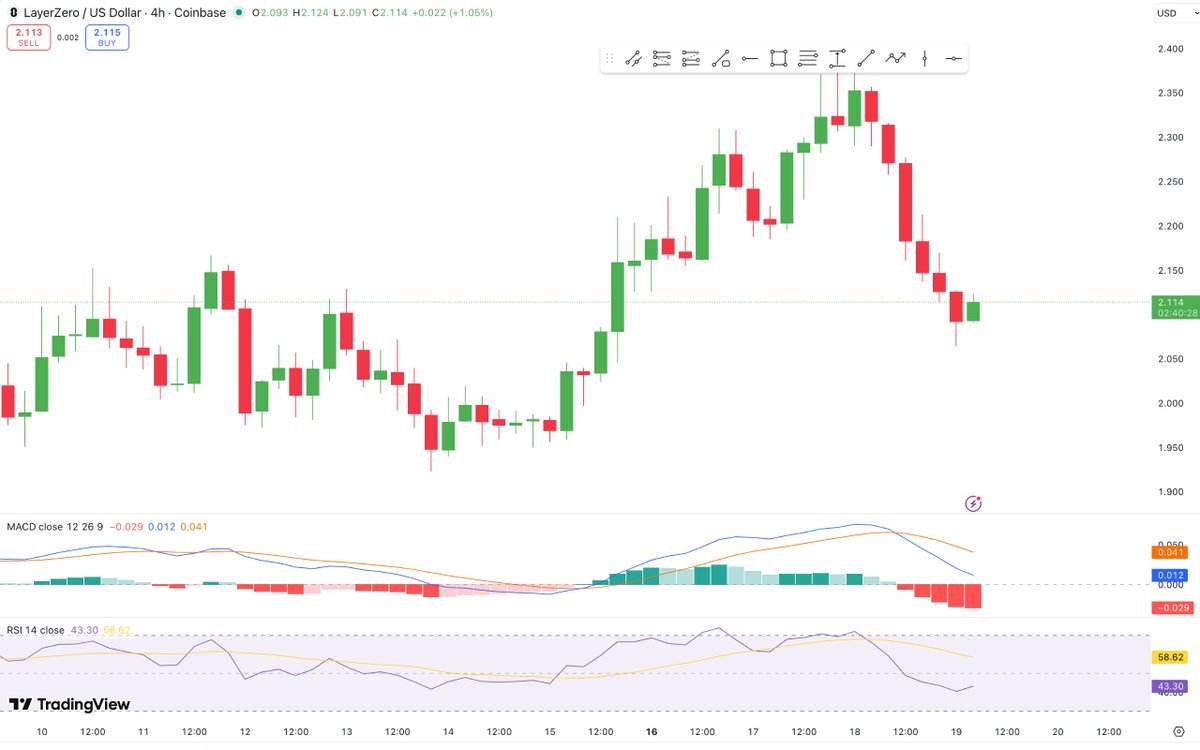 Source: TradingView
Momentum indicators correspond with the ongoing consolidation pattern. The Moving Average Convergence Divergence (MACD) displays a bearish intersection, with histogram bars extending into negative territory. The Relative Strength Index (RSI) registers 42.82, positioned beneath the neutral 50 threshold, suggesting persistent selling pressure that has not yet reached oversold conditions.
Near-term price trajectory depends significantly on ZRO’s interaction with the $2.09 support boundary. Maintaining this zone may facilitate horizontal consolidation, whereas a violation could trigger additional declines toward lower support structures.
Regarding upside potential, successfully recapturing the $2.20 level would signal renewed accumulation interest. Movement beyond this point could establish momentum toward $2.28 and potentially challenge the $2.35 area once again.
