


Key Takeaways
- Block has reinstated a minimum of 4 workers following February’s elimination of 4,000+ positions.
- Company headcount fell from approximately 10,000 to under 6,000 following 40% staff reduction.
- Certain rehires resulted from internal pressure by managers and department heads.
- At least one worker returned after company acknowledged administrative mistake.
- Mass terminations linked to organizational transformation and AI integration strategy.
Jack Dorsey’s financial technology firm Block has started reinstating a select group of workers months after implementing sweeping job cuts earlier in 2026. This development follows the company’s decision to eliminate more than 4,000 positions, which accounted for approximately 40% of its total workforce.
The reinstated employees represent a fraction of those initially let go, spanning various departments within the organization. Though Block hasn’t formally announced any comprehensive hiring reversal, these returns suggest certain positions underwent reconsideration during post-restructuring evaluations.
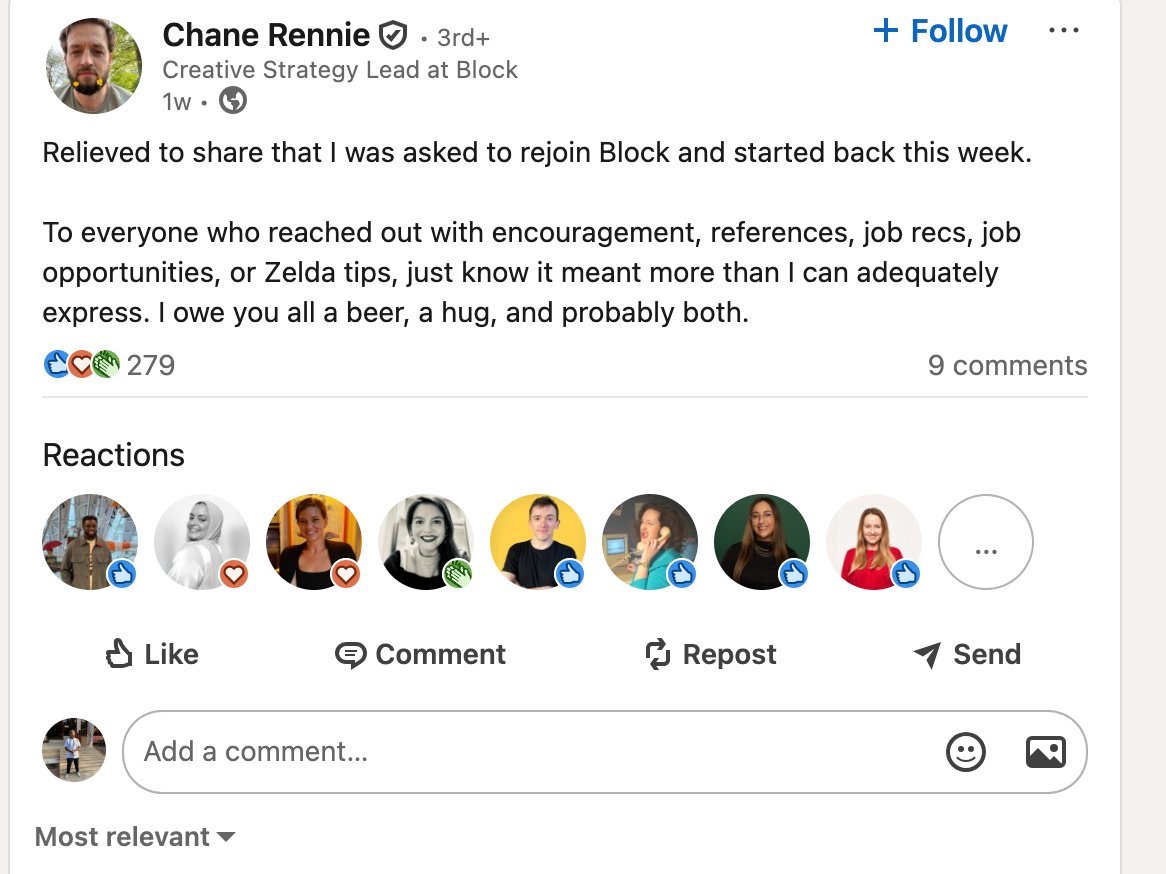
Among those brought back is Chane Rennie, who oversees creative strategy operations at Block. Rennie publicly confirmed his return to the organization shortly after initially disclosing his termination. Separately, Andrew Harvard, working in design engineering, revealed that his dismissal stemmed from an administrative mistake and received an invitation to rejoin soon afterward.
 Source: LinkedIn
These instances reveal a targeted reassessment of employment decisions executed during February’s downsizing, which dramatically contracted the company’s personnel from more than 10,000 workers to below 6,000.
Selective Reinstatements Indicate Focused Course Corrections
The volume of returning employees remains minimal relative to the magnitude of the original terminations. Available information confirms at least four individuals have been brought back, with no evidence suggesting a comprehensive rehiring initiative for displaced workers.
Certain reinstatements occurred through internal advocacy efforts. Richard Hesse, serving as technical lead for Square Online and Site Operations, disclosed that he urged executive leadership to restore team members after downsizing left him as the department’s only survivor. According to Hesse’s account, company leadership responded by bringing back select colleagues to reestablish functional capacity.
Additional employees described comparable experiences, reporting that supervisors and team coordinators raised concerns with upper management. In particular situations, these advocacy efforts culminated in employment offers extended to previously terminated staff.
Nevertheless, the organization has preserved its substantially diminished workforce size. The rehiring activity appears focused on addressing particular operational requirements rather than indicating a fundamental pivot in employment philosophy.
Automation and Organizational Transformation Shape Employment Approach
Block has characterized its workforce contraction as connected to organizational restructuring and shifting operational objectives. Jack Dorsey previously indicated the terminations formed part of a comprehensive initiative to reimagine the company’s operational framework.
we're making @blocks smaller today. here's my note to the company.
####
today we're making one of the hardest decisions in the history of our company: we're reducing our organization by nearly half, from over 10,000 people to just under 6,000. that means over 4,000 of you are…
— jack (@jack) February 26, 2026
Sector analysts have connected this decision to emerging patterns in automation and machine learning adoption. Balaji Srinivasan, previously serving as Coinbase’s chief technology officer, characterized the downsizing as an initial demonstration of what he termed an “AI cut,” referencing workforce reductions propelled by heightened dependence on automation capabilities and efficiency platforms.
This transition mirrors a widespread phenomenon throughout technology and cryptocurrency sectors, where organizations are recalibrating team compositions while implementing emerging technologies. Increasingly compact teams are anticipated to manage workloads formerly requiring substantially larger groups, enabled by software platforms and automated infrastructure.
Recent activities across the cryptocurrency landscape demonstrate comparable adjustments. Companies including Algorand, OP Labs, Gemini, and OKX have disclosed workforce reductions or organizational restructuring initiatives responding to market dynamics and operational modifications.
Block’s reorganization corresponds with this wider landscape, where firms navigate cost management alongside investments in emerging technological capabilities.
The organization hasn’t disclosed additional information regarding prospective employment plans. Present indicators suggest any subsequent rehiring will remain constrained and determined by particular operational necessities rather than representing a reversal of its previous workforce reduction.
While certain employees have rejoined the company, overall staffing numbers remain considerably below pre-layoff levels. The reinstatements appear designed to fulfill urgent requirements within specific departments rather than signaling a transformation in overarching strategic direction.
